
‘Is there enough evidence?’ Challenging health promotion policies in a World Trade Organization committee
Location
Room 1.55, Edinburgh Futures Institute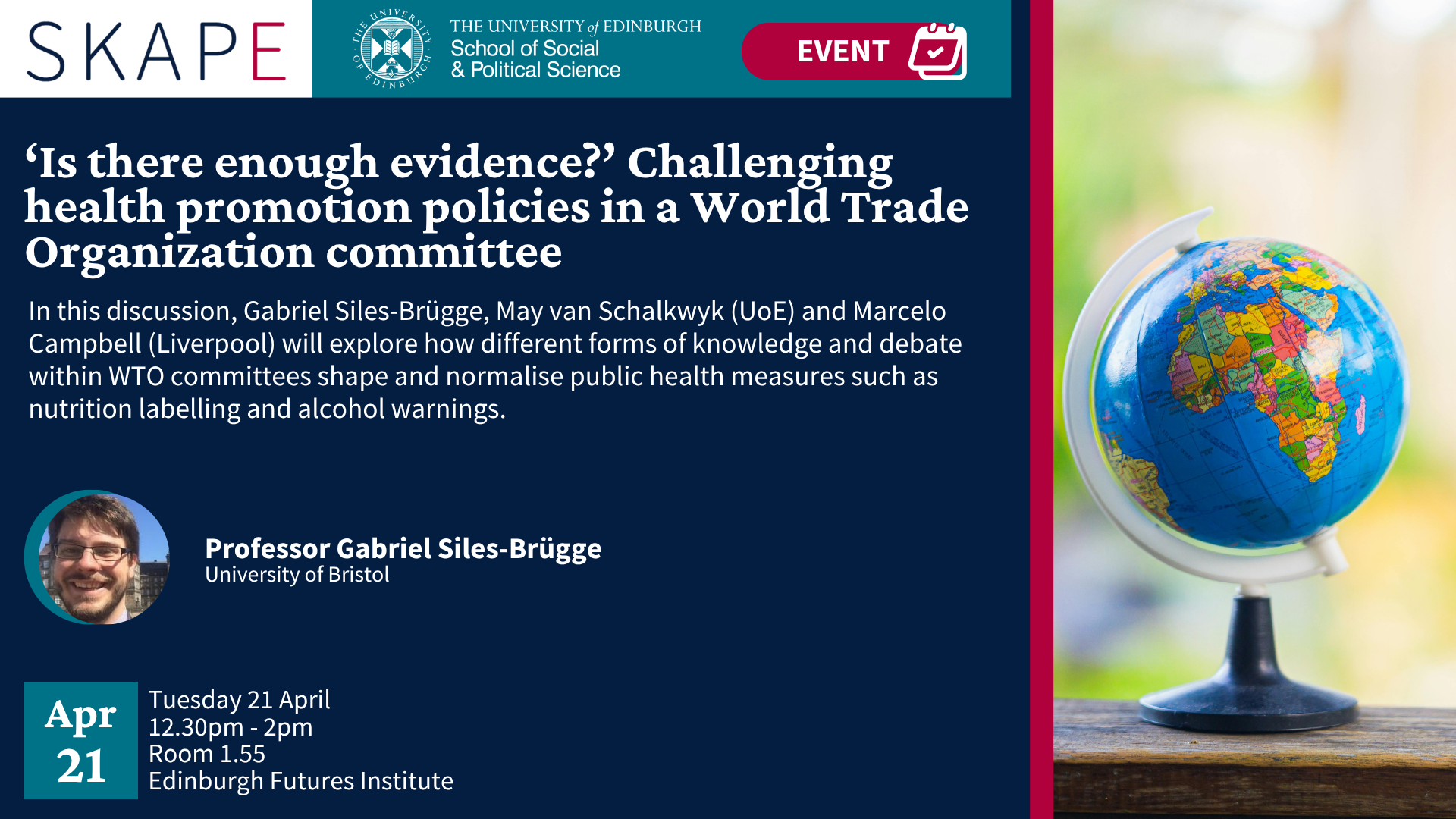
Click here to register on Eventbrite.
Abstract
International Political Economy scholarship on the World Trade Organization (WTO) has focused on high-level negotiations and formal dispute settlement, neglecting the important day-to-day work that continues in the organisation’s many committees despite the Appellate Body crisis. Public health scholarship has argued that member challenges to health promotion policies in bodies such as the WTO Technical Barriers to Trade (TBT) Committee can have a chilling effect on regulation, but has tended to see policy space in the Committee as fixed and subject to the production of sufficient evidence. Drawing on literature at the intersection of public policy studies of evidence and science and technology studies, we challenge this interpretation. Different forms of knowledge and their use by specific actors cumulatively shape epistemic norms and the wider legitimacy of policies. Drawing on interviews with trade policy and public health actors and an analysis of TBT Committee minutes, we home in on three types of non-communicable disease prevention policies: front of package nutrition labels, alcohol warning labels, and the regulation of packaging as a marketing device. Identifying key knowledge practices and brokers, we show that clashing norms surrounding knowledge use co-exist in the TBT Committee – from the deliberative to the more litigious. Over time, repeated discussion contributes to normalising measures and their epistemic justification.
In discussion with Marcelo Campbell, Liverpool Law School, University of Liverpool, and May van Schalkwyk, School of Social and Political Science, University of Edinburgh.
This study/project is funded by the UK National Institute for Health Research [NIHR204663]. The views expressed are those of the author(s) and not necessarily those of the NIHR or the Department of Health and Social Care.
Speaker Bio
Gabriel Siles-Brügge is Professor in Global Governance & Public Policy in the School for Policy Studies at the University of Bristol. His research is situated at the intersection of public policy, EU Studies and International Political Economy, where he has extensive policy expertise in the area of international trade. Gabriel's work over the years has focused on the (de)legitimation of economic policy through ideas, evidence, and expertise. He served as a Parliamentary Academic Fellow with the International Trade Committee of the House of Commons (2017-19), returning as a specialist adviser to the same Committee (2021-22). He was also a Policy Advisor on Trade Policy to the European Public Health Alliance (2016-2024). His current research is focused on the role of evidence in discussions at the intersection between the global health and trade policy regimes. Gabriel is also one of the Editors in Chief of the leading EU Studies outletJCMS: Journal of Common Market Studies.