
Developing the Fission-Fusion Concept: A Journey through the Arts, Humanities, Social Sciences and Natural Sciences (Part 2)
Dr Miranda Anderson is an Honorary Fellow in History, Classics and Archaeology at the University of Edinburgh and an Associate Lecturer at the Open University. She has held several prestigious fellowships and was principal investigator of an AHRC-funded project, titled ‘The Art of Distributed Cognition’, which involved collaboration with the Talbot Rice Gallery. Her work has investigated the relations between cognition and culture, particularly literary works, challenging the boundaries between disciplines and engaging with numerous contemporary science, technology and society (STS) questions. In this perspective article, she evokes the ‘fission-fusion’ concept on which she has been working for some years now – a concept that contributes to debates surrounding the issue of identity by drawing on the arts, humanities, social sciences, and natural sciences.
The particular ‘I’ that I am, came to the idea of fission-fusion from cognitive scientific research rather than from quantum physics. I base my approach on cognitive scientific and philosophical theories that claim that rather than being merely information processors or brain-bound, minds are distributed across the brain, body and world. The term distributed cognition is sometimes used interchangeably with 4E cognition, with the 4Es standing for embodied, enactive, embedded, and extended cognition. Embodied cognition argues that cognition is shaped by the body; enactive cognition views it as unfolding through engagements between organisms and environments; embedded cognition includes external resources as enabling factors, while extended cognition argues that the external resources are themselves part of the cognitive system. Drawing on scientific evidence from across areas such as cognitive science, neuroscience, philosophy of mind, psychology and linguistics, I have shown how this framework counters the elision of the body and the physical world by postmodern social constructivism. For the last two decades I have been exploring how these theories illuminate the nature and value of the arts and humanities, working with colleagues to uncover evidence of notions and practises of distributed cognition between classical antiquity and the twentieth century, as well as focusing myself on how it operates in culture and the history of ideas. [1] I aim now also to collaborate with other thinkers to consider its wider remits for contemporary culture and society, as well as for other non-western cultures throughout history.
Paradigms about distributed or 4E cognition are abiding because they capture abiding aspects of human nature. 4E accounts of mind lead to more awareness of the fundamental cognitive roles of embodiment and environment. Yet the emergence of their current conceptualisations from discourses of evolutionary adaptivity and the computing revolution in the mid-twentieth century led to a different form of elision: a tendency to view cognition’s distribution as necessarily beneficial, rather than realising negative aspects and ethical issues, or the significance of the capacity for separability and distinctness.
Questioning of the cognitive sciences’ focus on distribution as enhancing cognition arose across the periods examined in The Edinburgh History of Distributed Cognition series (2018-20). Historically new technologies and forms of sociocultural norms generated most critiques and resistance. For instance, during industrialisation anxiety arose around ways in which human cognitive capacities were impinged upon, degraded, or replaced by forms of mechanisation, systematisation and routinisation; then as we moved into the twentieth century, these expanded into concerns about the flourishing of nationalism, propaganda and the manipulation of the masses.
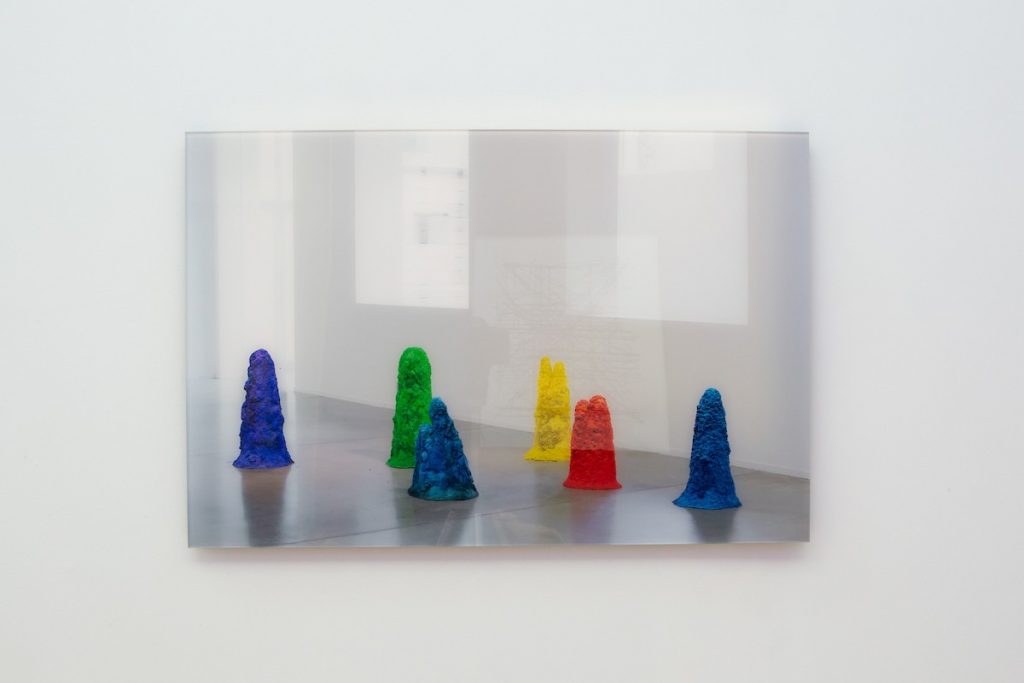
In our own society, the arts make visible why there should be anxieties about corporately motivated and under-regulated forms of technological domination. The internet, computers and mobiles enable the digitally connected to communicate instantly and remotely, fact-check, work, shop, socialise and protest or rebel against existing forms of power. Yet several artworks in The Extended Mind exhibition, which I curated with Talbot Rice Gallery, such as those by Agnieszka Kurant, cast light on the socio-economic and ethical dimensions of contemporary forms of distributing cognition across networks of minds. Kurant created A.A.I. by using unwitting termite colonies supplied with coloured sand and glitter, out of which they created mounds which she then sold as artworks to illustrate the silent exploitation of our collective intelligence, such that ’we no longer know when our labor or social capital is being stealthily harvested’. [2] Sociocultural, political, and economic systems and practices, and our conceptualisations of them, undergo myopic manipulations by multinational corporations wielding huge amounts of opaque power.
The development of the 4E cognition framework over the last thirty years heightened concern over what exactly could be used as a defining ‘mark of the mental’: a way of distinguishing the mental from the non-mental. [3] Using the ‘fission-fusion’ concept helps illuminate the fact that there is, in fact, no such defining ‘mark’. [4] This view is also complementary to predictive processing, widely posited for around the last decade as the means whereby the mind engages with the world. [5]
Fission-fusion complements Daniel Casasanto and Gary Lupyan’s theory of language. [6] In order to parse the nature of our engagements with the world, we require both Newtonian and more relativistic physics concepts. [7]
A fission-fusion approach chimes with decolonisation debates. [8] Artist and film director Steve McQueen resists reductive essentialising notions. [9] [10] Shakespeare’s Sonnets. [11]
Particular characteristics generate a ‘relative functional irreplaceability’. [12] Rousseau famously claimed that ‘One believes himself the others’ master, and yet is more a slave than they’. [13]
Find the first part of Dr Miranda Anderson’s post on the ‘fission-fusion’ concept here
Contact author information:
References
[1] Anderson et al. (2018–2020)...
[2] Kurant (2019)...
[3] Rorty (1970)...
[4] Wittgenstein (1999)...
[5] Hohwy (2013); Clark (2016)...
[6] Casasanto & Lupyan (2015)...
[7] Casasanto (YouTube)...
[8] ‘Decolonizing Art History’ (2020)...
[9] Steve McQueen interview...
[10] Steve McQueen SAG-AFTRA...
[11] Sonnet 8...
[12] Frankl (2019)...
[13] Rousseau (2019)...
Tags
- Advertisement
- Bio-politics
- Citizen science
- Climate change
- COVID-19
- Data
- Decarbonisation
- Deliberation
- Education
- Education governance
- Education policy
- Energy
- Environmental policy
- Environment
- Evidence
- Expertise
- Finance
- Education governance
- |Healthcare
- Health policy
- Immigration
- Impact
- Innovation
- Interview
- Lockdown
- Mental health
- Neuroscience
- NHS
- Pandemic
- Policy
- Policy translation
- Politics
- Psychiatry
- Public engagement
- Public health
- Public participation
- Public policy
- Quantification
- REF
- Research collaboration
- Research Excellence Framework
- Research management
- Science policy
- Social policy
- United Nations